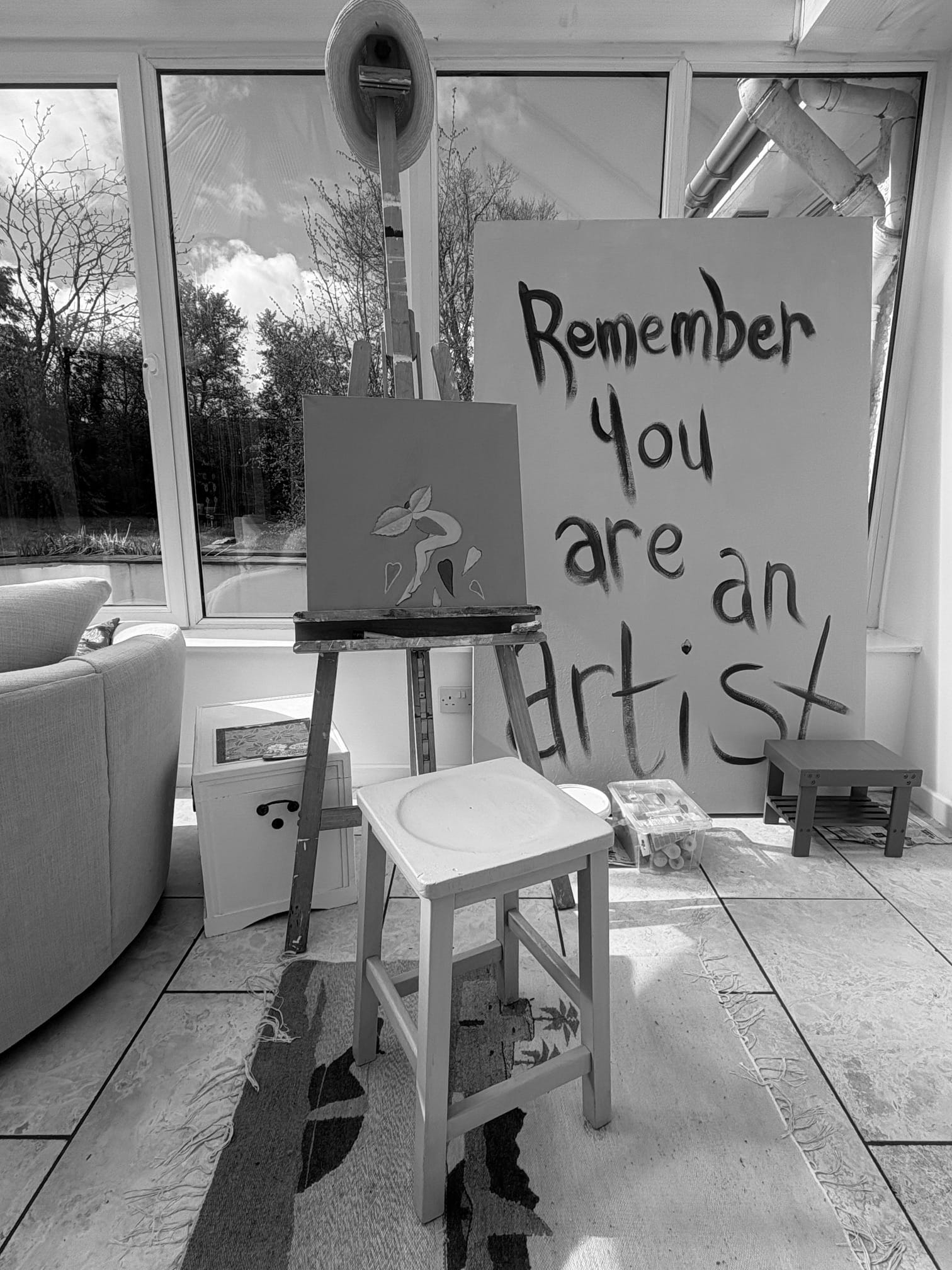
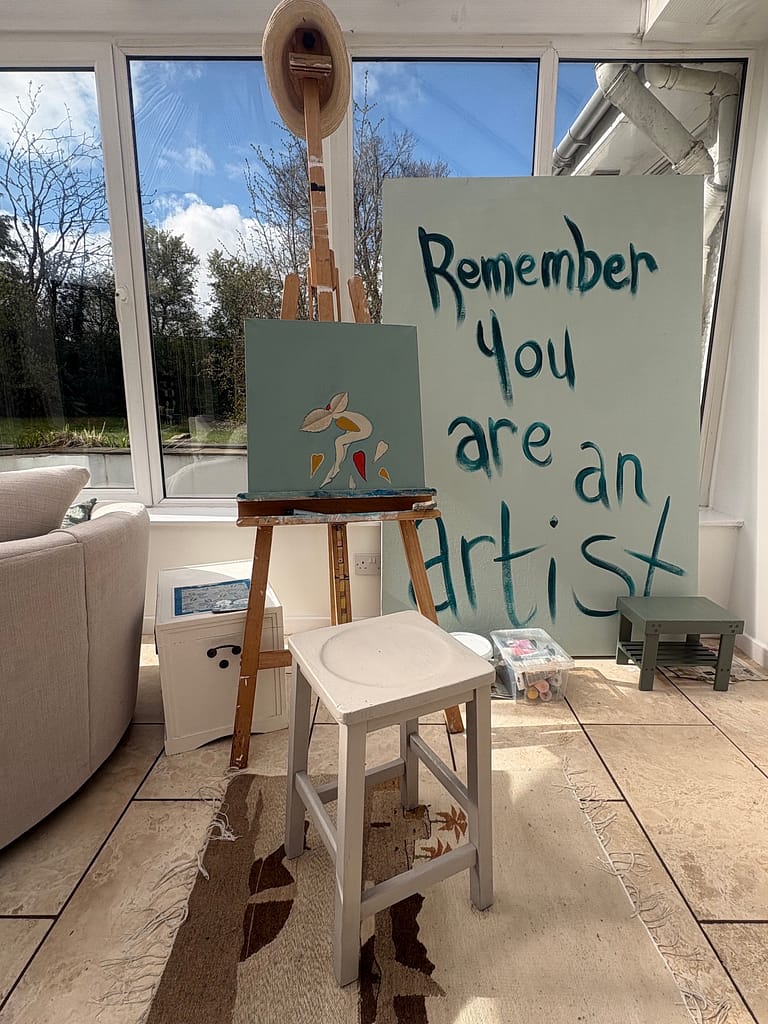
Alongside developing a health and wellbeing design practice, I’ve been consciously coaching myself back into my own creative practice.
I started out as an artist. I remember, age five, telling my mum, I wanted to go to art school, because at that age, that’s where I thought I’d really become one. I’ve no idea where I got the idea from. My parents were language teachers.
I did go to art school, accepted straight from school, aged 17, on the basis of my portfolio, without an interview.
At one point I was told I was the most creative person in my year. Despite significant health challenges at the time, I went on to graduate as one of the top three students. It wasn’t something I fully understood then, but the comment stayed with me. At times, when I watched my own art practice drift further and further away over the years, the sensation washed over me like waves of grief associated with a major loss.
For years, like many people, artistic practice became something that got pushed aside, kept secondary to work, structure and responsibility, devalued as realistic or valuable, especially as a young solo focused on building a financially stable life. I carved out a precarious but more productive behind-the-scenes career in film and TV production, balancing that with a pull towards community development, education and social enterprise work. My creative work became developing structures for others’ creative work to grow and thrive in instead.
In that respect, I wasn’t special. A lot of artists are told some version of ‘secure a viable income and keep art as a hobby’. On one level, that is practical advice but it also reduces personal creative practice to something optional, something decorative, luxury even, that sits outside the serious business of life.
My creative energy didn’t disappear. It got redistributed into different forms of problem-solving, production and systems thinking.
Years later, someone contacted me on Facebook. They had found some of my old work that art school staff had thrown in a skip. They said they hoped I was still making work, and felt compelled to reach out and say so.
I wasn’t. At least not the kind of work they had found.
At the time, I was fully embedded in work that felt more necessary, forward-moving and in need of all my resources, but work that was increasingly distant from making things with my hands, ideas and attention in my own original way.
The thing is, for many people, art doesn’t function as a hobby at all. It functions more like a health practice, a way of maintaining attention, processing experience and staying connected to themselves. Not in a simplistic self-care sense, but in the deeper sense of maintaining psychological and embodied equilibrium. The act of making can be a way of metabolising experience. It gives shape to things that otherwise stay unprocessed or diffuse.
It’s not for nothing that during the long hot spring of the first 2020 lockdown, while pivoting the business I’d contributed to establishing online to help sustain us over the coming years, I set up my easel outside and started to paint birds.
The act of making can be deeply regulatory, less about productivity or career and more about coherence. When you remove that practice for too long, it doesn’t feel like you have lost a pastime. It can feel like a disconnection from yourself, not always dramatic or visible but cumulative.
More recently, I’ve started returning to art, not as nostalgia, but as practice, exploring now and then as an integrated experience. Treating it not as another thing to find time for, in the fragments left over from an exhausting day, but as something to design into my life again.
That has meant returning to drawing and painting, developing new work, spending time with older archived pieces that have been left behind, now open to be rediscovered and reengaged with through a kinder, more compassionate lens, and planning outlets for my art to exist in public.
It hasn’t come because it’s being justified externally, it’s because some internal system is rebalancing itself.
There is something interesting about revisiting earlier work. Much of it was created before social media when I thought nothing of sitting all day at home or later in my studio, entirely undistracted and focused only on what was forming in front of me, regularly completing one, two or several artworks I was working on.
I’m also exploring how this work, and my health and wellbeing practice, might exist outside of social media – in exhibitions, publications, physical spaces and slower forms of attention restoring engagement.
This process is less about productivity and more about reconnection. I’m not making up for lost time or clambering late into capturing the fragmented attention now scattered on digital platforms. I’m reconnecting with the process of making things that don’t need to be constantly visible or immediately accessible, with focused attention. What’s coming to me slowly in the moments of one to one presence, me and my artwork, is what feels valuable now.
It’s not a pivot from the work I have built up to sustain me professionally and financially in the same way my health and wellbeing practice isn’t a pivot but a naturally expanding evolution of what I do and what I need. It’s all part of the same unfurling thread: fueling my own sustainable wellbeing, attention restoration and returning to what feels fundamentally alive in my system in order to help others with theirs.
In many ways it mirrors the same principle I bring to coaching. A sustainable practice comes from integration, not intensity. Wellbeing, creativity, work and identity are not separate projects. They are different expressions of the same capacity to stay connected to what matters.
I’ve realised coaching, production work, systems and programme design, all carry creative intelligence. They were never separate from the artist identity so much as alternative channels for it, but they don’t fully replace the specific function of making physical or material work that exists outside immediate utility.
Art practice is coming back to me naturally and without force, reappearing as the conditions allow them to, not as ambition, but as restoration.
Leave a Reply