How riding creates full sensory attention, regulates stress and builds present moment awareness.
A lived example of how movement can quiet mental noise and sharpen focus.
Motorbiking isn’t usually the first thing that comes to mind when people think of meditation, or wellbeing practices. For many non-riders, it sits firmly in the category of noise, risk and exhaust fumes, on a fast-moving machine associated more with danger and disruption than calm and clarity.
It might, therefore, come as something of a surprise that for many riders, motorbiking isn’t an escape from mindfulness at all, but a direct route to it.
Motorbiking has taught me more about attention than most structured practices ever managed.
Meditation is often understood (or misunderstood) as the act of emptying the mind, retreating from stimulation and activity or softening attention. Riding challenges that idea completely.
On a motorbike, nothing is switched off. Mind, body and environment are fully engaged all at once with perception, timing, balance and movement all operating together in real time.
What emerges isn’t mental silence, but convergence, with everything I am thinking, sensing and doing drawn into a single point of focus, aligned toward one continuous aim – staying present, responsive and precisely in tune with the road as it unfolds.
This kind of mindfulness is about sustained, non-fragmented attention to present experience.
On a motorbike, I am continuously aware of external sensory input (sound, vibration, speed, weather, road surface, other vehicles), internal states (fear, focus, anticipation, vigilance, calm, joy) and rapid decision-making. All anchored in what is happening right now.
It’s a completely different experience of multi-tasking to the kind which now fractures much of our modern day-to-day experience.
On a motorbike (at least the kind I ride) there are no screens, no constant stream of digital interruptions or overlapping conversations pulling me in different directions, no drifting into elsewhere.
There is a particular moment on a solo ride when everything becomes quiet.
Not silent, as the engine is always still beneath me, but internally quiet. My mind settles and my nervous system organises itself.
This is not escapism. It is regulation. Presence in my experience. Somatic practice.
It didn’t come naturally but learning to ride a motorbike became a turning point for me in how my nervous system responds to pressure. What used to feel like anxiety gradually settled as I learned to stay present in motion.
The Body Comes First
For me, solo motorbike travel isn’t about speed, risk, or spectacle. It has become a form of embodied meditation, a constantly developing connection between body, machine, landscape, and my awareness.
And, unexpectedly, one of the most powerful wellbeing journeys of my life.
Somatic practice begins with the body as the primary site of intelligence. Motorbiking requires this intelligence.
On a motorbike, I can’t override my physiology for long. If I am are tense, distracted, dissociated, or overwhelmed, my bike tells me immediately. My grip tightens. My breath shortens. My steering becomes rigid.
The body gives feedback in real time.
Unlike many areas of modern life, where we can override exhaustion, numb stress, and push through disconnection, riding requires coherence – steady breath, soft but alert vision, relaxed shoulders, fluid hips, and responsive hands
That demand for integration is what makes it somatic.
Regulation through rhythm
There is a rhythm to riding – acceleration, steady cruising, deceleration, stillness.
The nervous system tunes into this rhythm. Breath syncs with speed and the terrain. Micro-adjustments in posture create subtle internal awareness. Like yoga, dance, or long-distance running, all of which I’ve also found a supportive rhythm for life through, riding creates repetitive patterned movement combined with sustained attention. The mind can’t spiral far into rumination when it’s in focused motion. It has to remain present for the road, the curve, the surface, the environment.
Over time, this has built emotional regulation, nervous system resilience, deeper concentration, and expanded awareness.
I’ve come to understand riding as a form of moving meditation which me a clear sense of peace, not in the soft, sleepy sense but deeply regulating in a nervous system sense. I’m more alert, awake, and less scattered.
Solo Travel and Nervous System Autonomy
Riding alone, especially away from home, adds another dimension.
Without conversation, distraction, or social mirroring, I meet my own internal landscape directly. There is no escape.
There is, however, space to notice anxiety before a mountain pass, fatigue after long hour, the subtle (and often not so subtle) joy in an open stretch of road, fear rising then falling and confidence building in my body as I relax into the ride.
In these moments, I can’t outsource decision-making. I’m also not performing for anyone else. My autonomy takes centre stage.
I can feel the weather shift, the terrain changing, my own edges.
And I’ve learned to regulate through that.
There is something about controlled risk that sharpens presence. Mentally stepping out of the moment on a motorbike to something more comfortable or convenient has significant and immediate consequence. Fragmentation becomes unsafe, so attention becomes embodied rather than intellectual.
Learning to move through anxious states balancing a 220kg machine moving at 70mph in wind and rain on the open road or navigating a country road on the other side overseas also does something that’s hard to replicate anywhere else. There is nowhere to safely split myself off from the experience. When a tightening of the chest shows up, an urgency in the mind, or a spike of doubt, I don’t get to step aside from it. I have to stay functional inside it.
Over time, I have noticed what happens in my body on my rides carries over to the rest of my life.
That comes to matter. Learning experientially rather than intellectually that discomfort doesn’t automatically equal loss of control. You can feel unstable internally and still remain precise externally. You can be flooded with sensation and still make clean, measured decisions to protect yourself and others.
Off the bike, the body remembers what it has handled on it.
This is one of the reasons why I’m interested in movement-based approaches to wellbeing. Not as an escape from life but as training for how to stay present inside it.
The Intelligence of Speed and Slowness
Motorbiking carries cultural associations with danger and adrenaline. But when approached consciously, true riding skill is not about agression, it is about sensitivity (something undervalued in our culture) – reading the road, sensing traction, adjusting pressure, anticipating movement in others, and choosing when to slow.
This mirrors life. We are constantly navigating acceleration and pause, ambition and recovery, output and restoration.
Riding becomes a physical rehearsal for balanced momentum, and sustainable wellbeing.
The Landscape as Co-Regulator
When travelling across countries alone, the landscape becomes a co-facilitator of regulation.
The mountains slow me and soften anxiety with awe.
The coastlines open breathing and flood sea air in.
Pine forests soften attention as I inhale my favourite natural wild scents.
The expanse of open moors and plains expands perspective.
Nature regulates the nervous system through visual depth, sound, air quality, and horizon lines. On my bike, I am not separated from the environment by glass and insulation. I am in direct contact with it, with every shift it makes out with my control – temperature, scent, wind direction, altitude. I adapt.
This sensory immersion in the elements brings me not only into nature, but reminds me how much I am part of the elements too.
Trusting the Body
Perhaps the deepest therapeutic aspect of solo riding is the cultivation of self-trust.
Trust in my reflexes, my judgement, my preparation, my boundaries, my intuition, my capacity to navigate the unknown.
This is not where bravado lives. It where quiet confidence becomes embodied.
Each completed journey becomes stored evidence in the nervous system: I meet challenge. I regulate through uncertainty. I move through fear without collapsing and experience journeys I always dreamed of, never imagined and have yet to dream of.
That imprint transfers into daily life, leadership, creativity, and relationships.
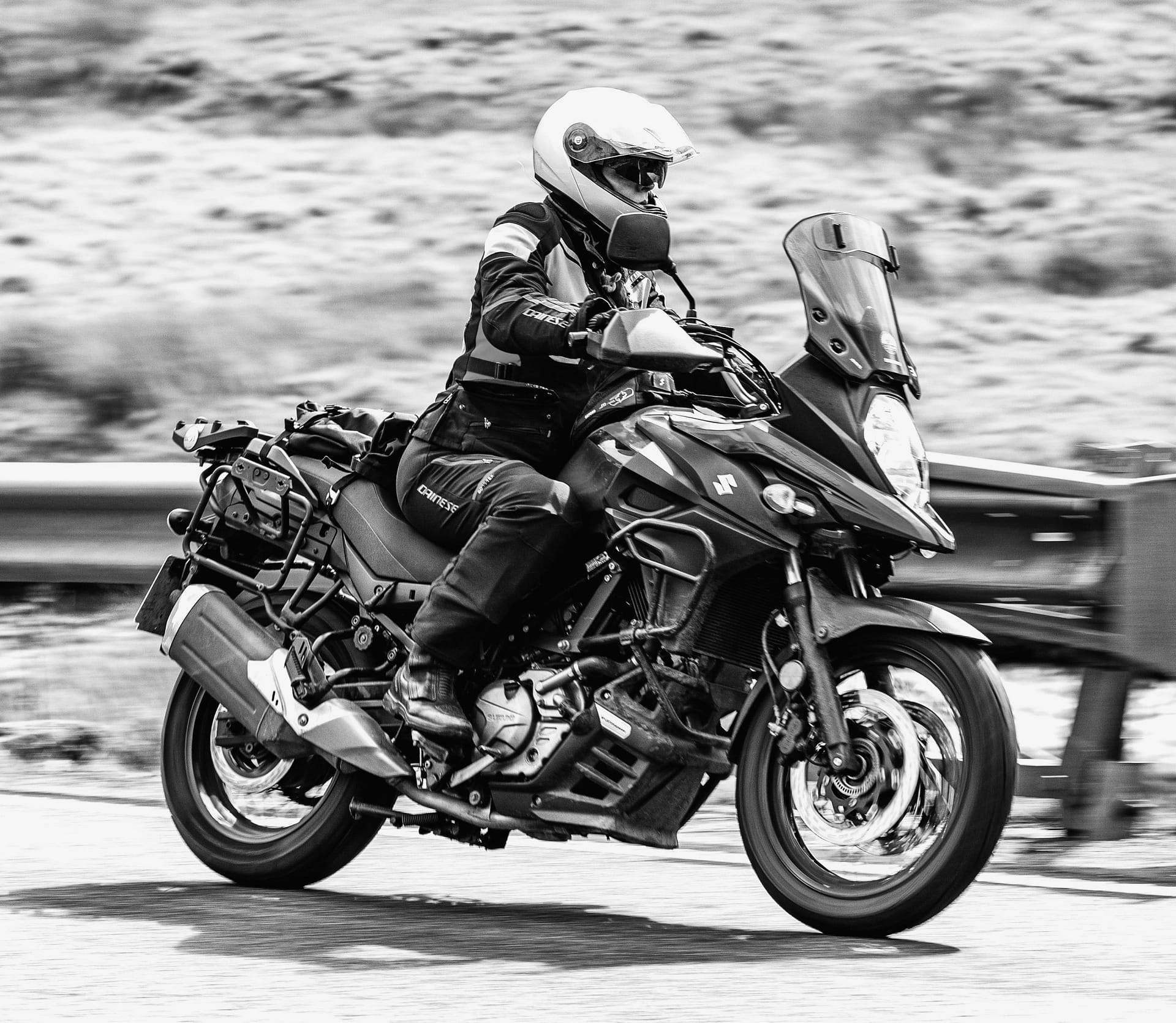
Photo credit: Biker Pics
Taken on the Rest and Be Thankful – my favourite name for a road.